Technology
Credible systems architecture—not slideware
This page reflects the engineering reference behind VerifiedSignal: presigned uploads, worker orchestration, deterministic LLM settings, Postgres as truth, and OpenSearch as a derived plane.
Stack overview
AWS-native core with clear separation of concerns
Frontend delivery, identity, object storage, OCR, and LLM inference map to managed services so teams spend integration effort on scoring quality and review UX.
AWS Amplify
Frontend hosting and global edge delivery.
Amazon S3
Object storage with presigned URLs for direct uploads, reducing unnecessary compute on the hot path.
Amazon Cognito
Authentication, including paths that align with AWS Marketplace–native identity flows.
Amazon Textract
High-accuracy OCR for tables, forms, and document geometry.
Amazon Bedrock
LLM reasoning (for example Claude 3.5 / Llama 3) for structured scoring and agentic sanity checks.
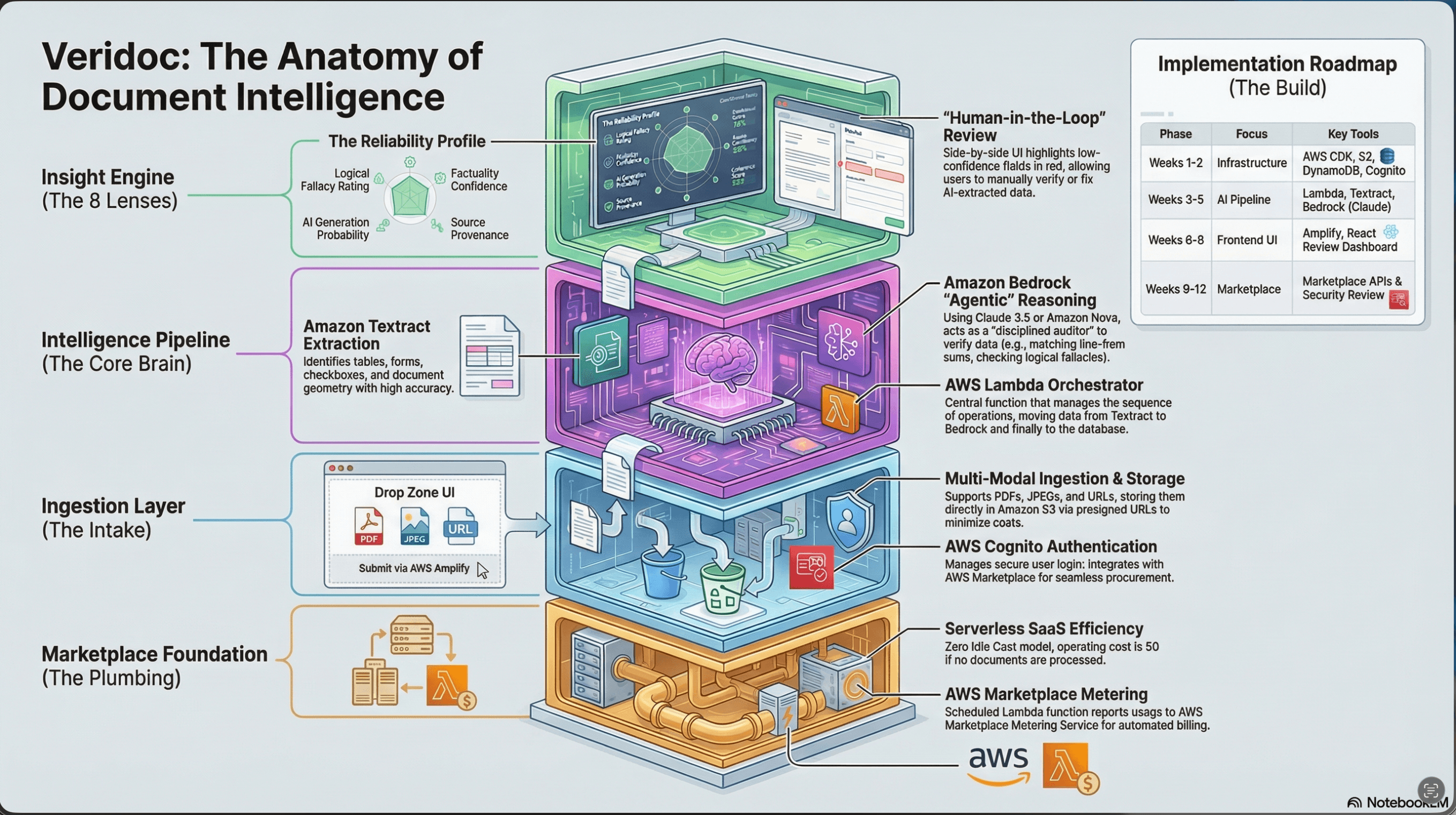
Visual overview
System architecture infographic
End-to-end view of major components, flows, and integrations.
Data plane
PostgreSQL is canonical; OpenSearch is derived
PostgreSQL is the system of record: users, permissions, final scores, billing, and authoritative outcomes. Amazon OpenSearch holds derived search and analytics state: full-text search, kNN vectors, and dashboard aggregations—treated as expendable relative to Postgres.
System of record
PostgreSQL is the system of record: users, permissions, final scores, billing, and authoritative outcomes.
Search & analytics
Amazon OpenSearch holds derived search and analytics state: full-text search, kNN vectors, and dashboard aggregations—treated as expendable relative to Postgres.
Pipeline
Eight-stage ingestion and scoring pipeline
From queued intake through Bedrock scoring, canonical persistence, OpenSearch indexing, and SSE completion events.
Step 1
Intake
Client submits file or URL; API creates a queued record in Postgres.
Step 2
Acquisition
Worker fetches bytes, computes content hashes, and deduplicates.
Step 3
Extraction
Textract/worker extracts plain text and structure; progress published to Redis.
Step 4
Enrichment
Metadata, topical tags, and initial quality flags.
Step 5
LLM scoring
Worker calls Bedrock for structured analysis via the Converse API.
Step 6
Canonical persistence
Validated scores written to the authoritative PostgreSQL layer.
Step 7
Search indexing
Document indexed into OpenSearch for retrieval and analytics.
Step 8
Completion
Final status pushed to the frontend via SSE.
LLM layer
Auditor-style prompting and strict structure
Temperature at zero, schema discipline, and few-shot examples that include graceful failure reduce hallucinated fields.
- Auditor-style prompting with strict structure (for example XML-style sections) and JSON schema enforcement—including sanity checks such as totals matching line items.
- Few-shot sets covering success, graceful failure (explicit nulls when data is missing), and messy edge documents to reduce hallucinated fields.
- Low temperature (0.0) for deterministic, “boring auditor” consistency.
Streaming UX
Server-Sent Events and incremental field hydration
Nginx should disable proxy buffering for SSE (for example `X-Accel-Buffering: no`) so streams reach clients reliably.
Partial JSON token parsing streams fields to the UI as they complete; field state progresses through unseen → in progress → complete → validated → persisted.
{
  "event": "stage",
  "document_id": "doc_123",
  "stage": "extract_text",
  "status": "running",
  "timestamp": "2026-03-26T22:11:10Z",
  "progress": 35
}
Marketplace & metering
Subscription plumbing and usage reporting
Patterns for AWS Marketplace tokens, customer resolution, and scheduled metering that align billable usage with Postgres-grounded counts.
- Marketplace subscriptions arrive with an `x-amzn-marketplace-token`; the backend exchanges it for a customer identifier linked to billing.
- Scheduled metering (for example hourly) aggregates document usage from Postgres and reports to AWS Marketplace Metering for usage-based plans.
Deployment
Targets from local to AWS
The reference explicitly supports bare-metal style dev, containerized compose, and Fargate/RDS/OpenSearch Service production shapes.
- Bare metal / local: filesystem or MinIO and single-node OpenSearch for development.
- Containers: portable Docker Compose for repeatable environments.
- AWS: production-style topologies using ECS Fargate, RDS, and Amazon OpenSearch Service.
API-first posture
Integrations and exports
Higher tiers expose CSV/JSON export and API access in the reference packaging—ideal for analysts wiring scores into notebooks, GRC tools, or newsroom CMS hooks.
Security & governance
Explicit failure mitigations
Operational resilience is specified: malformed JSON, search outages, worker crashes, and Redis loss each have a playbook.
| Dimension | Mitigation strategy |
|---|---|
| LLM returns malformed JSON | Incremental parser with field-level validation; fallback to a final pass parse. |
| Search unavailable | Persist to Postgres first; retry indexing later; UI shows search as pending. |
| Worker crash | Idempotent stage checkpoints so work resumes from the last saved state. |
| Redis outage | UI falls back to polling; event logs persist in Postgres for replay. |
MVP scope
What the reference explicitly defers
Clarity on exclusions keeps delivery honest: no custom training, no complex multi-tenant RBAC for MVP, no native mobile shell.
- Custom model training (stay on foundation models for MVP).
- Complex multi-tenant roles (admin-first MVP).
- Dedicated mobile apps (responsive web only).
Go deeper with the team
Architecture reviews, threat modeling, and integration design for your AWS estate.